Introduction: Designing for High-Pressure Transit Environments
Public transportation systems operate in one of the most demanding UX environments. Users interact with products while standing, walking, boarding vehicles, navigating crowds, and making time-sensitive decisions. Unlike typical consumer apps, failure in transit UX has immediate consequences—missed trains, delays, confusion, and loss of trust.
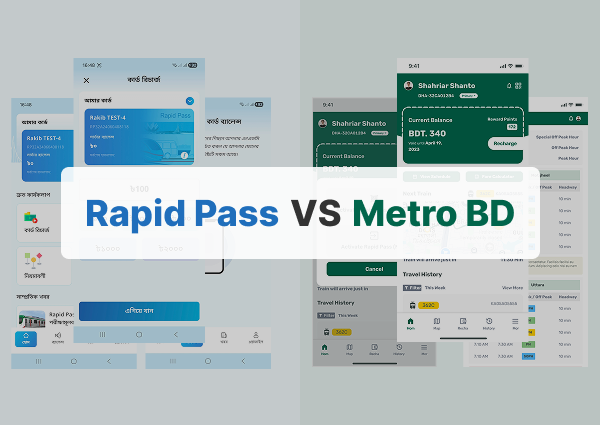
This case study presents a comparative UX analysis between Rapid Pass BD, a live public transit payment system currently used in Bangladesh, and Metro BD, a conceptual UX project designed to explore an ideal, commuter-first metro rail experience.
The purpose of this comparison is not to position one as “better” than the other, but to demonstrate how design intent, system constraints, and prioritization shape user experience outcomes. By comparing a production-grade, infrastructure-led system with a future-facing, experience-led concept, this case study highlights critical UX decisions that impact clarity, confidence, and usability in real-world transit environments.
What This Case Study Demonstrates
This case study showcases:
End-to-end UX thinking, from problem framing to interaction design
Trade-offs between system-driven and user-centered design
Mobile-first UX decisions in high-movement, high-pressure contexts
Accessibility-aware information architecture
Translation of complex transit systems into task-oriented experiences
Product thinking applicable to real-world public infrastructure
Project Context
Rapid Pass BD (Live System)
Rapid Pass BD is a nationwide public transit payment platform designed to support fare collection across multiple transportation modes. As a live public system, it must balance usability with operational stability, regulatory compliance, and infrastructure scalability.
Primary objectives
Enable secure, reliable fare payments
Support phased infrastructure rollout
Ensure system uptime and transaction accuracy
Align with public policy and operational constraints
UX implication Because Rapid Pass BD is tightly coupled with physical infrastructure and public operations, UX improvements must be incremental and low-risk. As a result, the experience centers on payments, balances, and account management rather than end-to-end journey support.
Metro BD (Concept Project)
Metro BD is a conceptual UX project created to explore what a modern metro experience could look like if designed from the commuter’s perspective first.
Primary objectives
Reduce uncertainty during travel
Improve journey predictability
Provide real-time, contextual information
Minimize cognitive load in transit environments
UX implication Freed from legacy systems and policy constraints, Metro BD serves as a design exploration for future-ready transit UX patterns, focusing on clarity, guidance, and confidence throughout the journey lifecycle.
Design Problem
How might we design mobile transit experiences that allow users to complete journeys with clarity, confidence, and minimal effort—especially in time-sensitive, high-movement environments?
Key contextual challenges
Users interact while walking, standing, or boarding
Decisions must be made quickly
Errors result in immediate friction or delays
Network connectivity may be inconsistent
Users vary widely in digital literacy and accessibility needs
UX Strategy: Commuter Mental Models
Effective transit UX must align with commuter mental models, not system architecture.
Observed commuter intent
Where am I going?
How do I get there?
How much will it cost?
When should I move?
Am I on the right path?
This intent framework becomes the foundation for comparing Rapid Pass BD and Metro BD.
Core UX Comparison
Onboarding and First-Time Experience
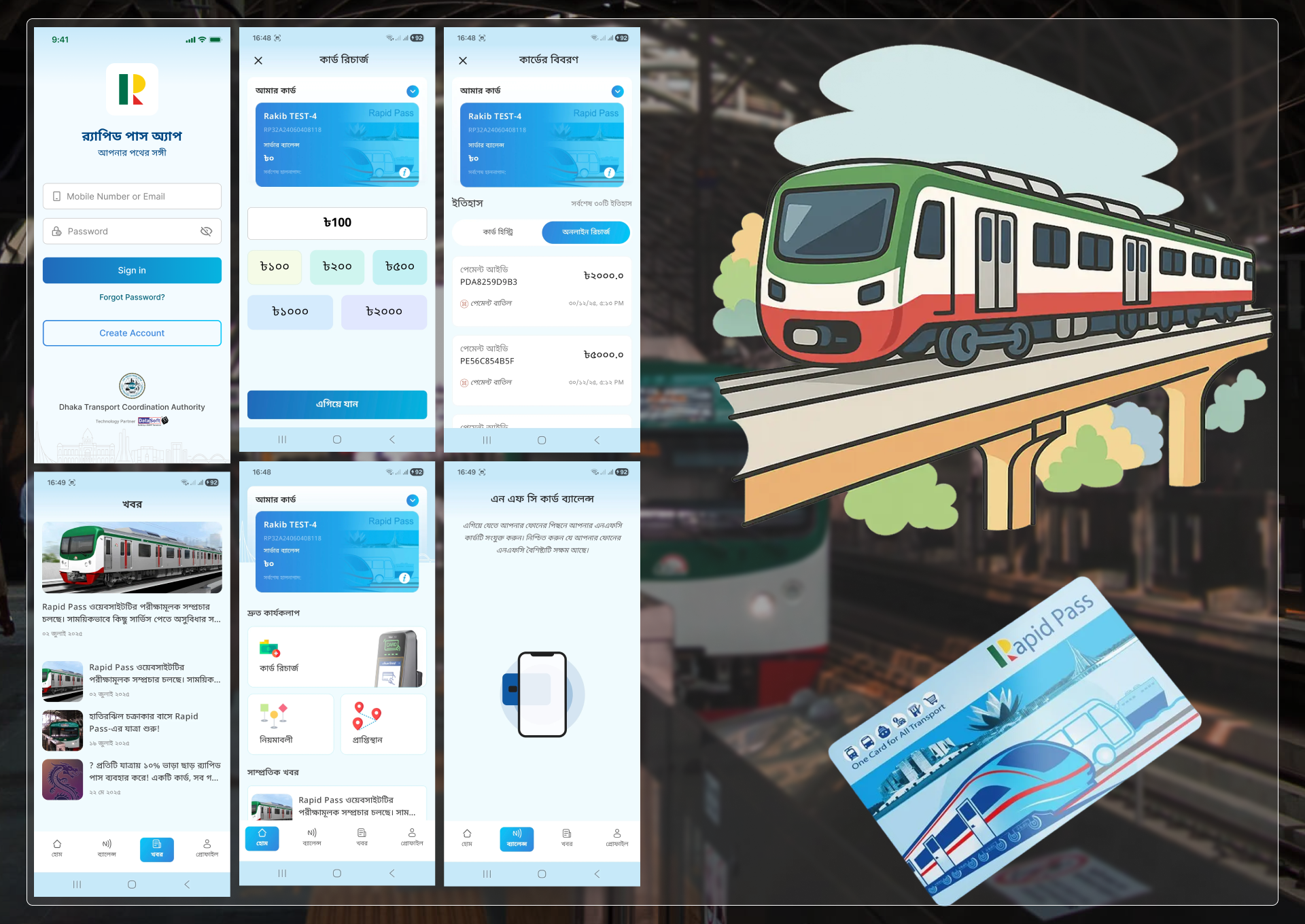
Rapid Pass BD
Standard login and authentication flow
Initial exposure focuses on card balance and transactions
Limited contextual guidance for first-time users
UX impact The experience assumes prior familiarity and requires users to mentally bridge payments and journeys, increasing early cognitive load.
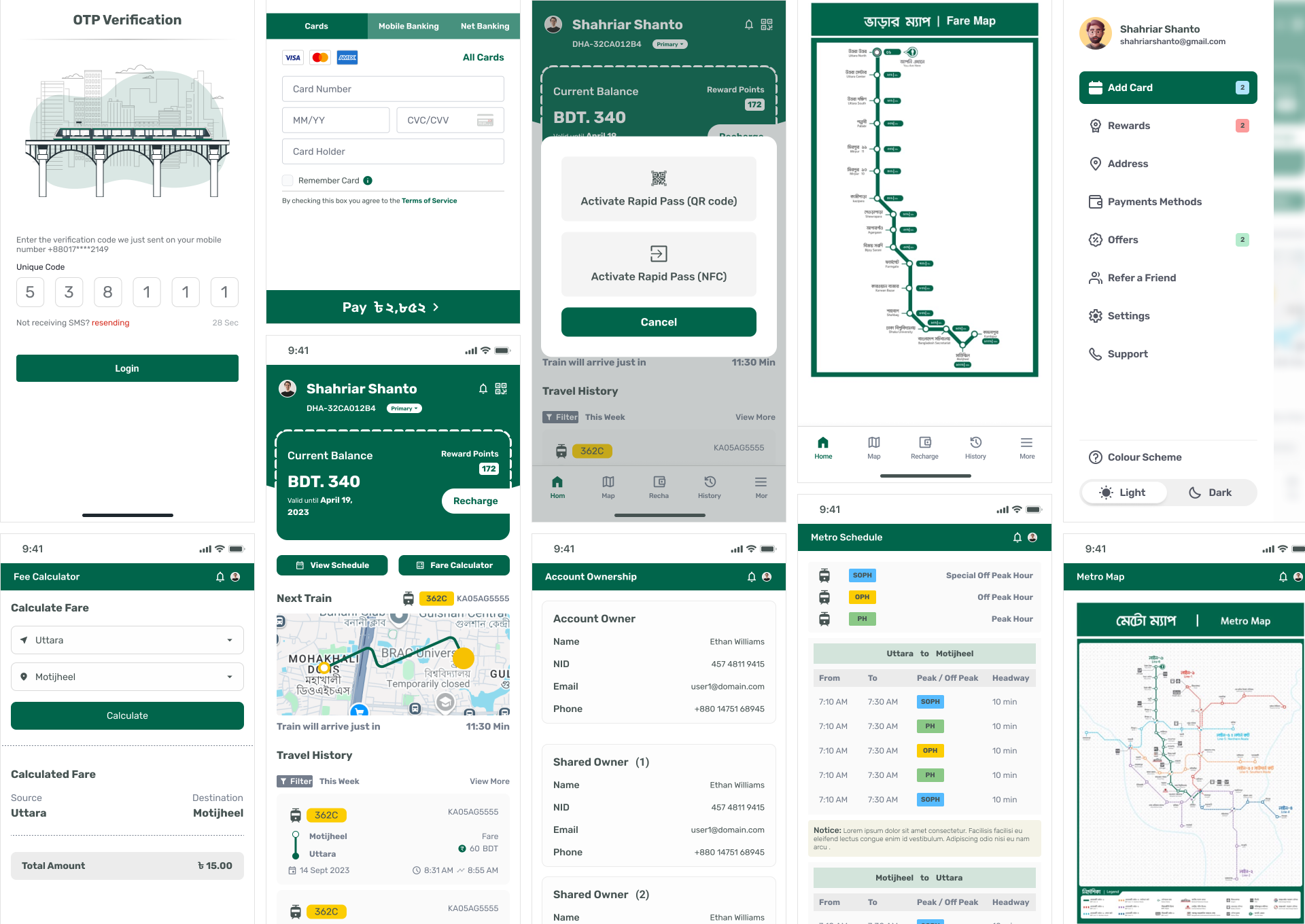
Metro BD
OTP-based, low-friction authentication
Introduces journey planning and fare visibility early
Establishes user intent from the first screen
UX insight In transit systems, onboarding should establish purpose before functionality. Commuters care less about stored value and more about how the system helps them reach a destination.
Information Architecture
Rapid Pass BD
Feature-centric navigation
Structure mirrors backend systems (cards, balance, recharge)
Journeys are implicit rather than explicit
Metro BD
Task-centric navigation:
Plan journey
View fare
Track arrivals
Travel history and recharge
Design rationale Metro BD mirrors natural commuter workflows: Search → Decide → Pay → Travel → Confirm This alignment reduces the need for users to translate between digital interfaces and physical transit environments.
Fare Experience
Rapid Pass BD
Balance-first interaction model
Fare visibility is secondary
Users infer affordability rather than being informed
Metro BD
Fare displayed per route and destination
Cost clarity before payment or movement
Supports informed travel decisions
UX impact Transparent pricing reduces anxiety, improves trust, and enables better route and timing choices.
Real-Time Decision Support
Rapid Pass BD
Limited real-time information
Focus on transaction history
Users rely on external sources for arrival updates
Metro BD
Real-time arrival indicators
Movement-aware prompts
Contextual wayfinding and guidance
UX insight In transit, real-time relevance outweighs historical accuracy. Users value knowing what to do next more than reviewing what already happened.
User Flow Capability Comparison
Capability
Rapid Pass BD
Metro BD
Journey planning
No
Yes
Fare estimation
No
Yes
Recharge
Yes
Yes
Real-time updates
No
Yes
End-to-end journey flow
No
Yes
Accessibility and Inclusivity Considerations
Rapid Pass BD
Functional but text-heavy
Requires familiarity with system terminology
Limited contextual assistance
Metro BD
Clear visual hierarchy
Glanceable UI for quick comprehension
Predictive guidance reduces reading and decision load
Accessibility insight Effective transit UX minimizes the need to stop, read extensively, or interpret complex information under pressure.
UX Metrics and Experience Indicators
Metric
Rapid Pass BD
Metro BD
Ease of onboarding
Medium
High
Real-time decision support
Low
High
Task completion effort
Medium
Low
Accessibility readiness
Needs improvement
Integrated
Key Experience Areas
Rapid Pass BD
Card dashboard
Recharge workflows
Balance and transaction history
The experience is reliable and stable but places a higher cognitive burden on users to map payments to journeys.
Metro BD
Source-to-destination planning
Upfront fare visibility
Live arrival tracking
Station and route guidance
The system actively supports users throughout the entire journey lifecycle.
UX Challenges and Insights
Rapid Pass BD
Challenges
UX constrained by infrastructure and policy
Payments prioritized over journeys
Limited real-time feedback
Insight Live public systems must balance UX improvement with operational risk, resulting in gradual experience evolution.
Metro BD
Strengths
Experience-led design decisions
Predictive, contextual support
Reduced uncertainty during travel
Insight Concept projects are essential for exploring UX directions that can later inform production systems.
Design Approach and Execution
UX thinking
Framing problems from commuter context
Designing for stress, motion, and urgency
Treating cognitive load as a primary metric
Execution strategy
Task-based interaction models
Real-time feedback loops
Mobile-first, glanceable UI patterns
Collaboration mindset
Balancing ideal UX with real-world feasibility
Producing handoff-ready design artifacts
Deliverables
User flows
Wireframes and prototypes
Interaction models
Responsive UI systems
UX Outcomes
For users
Reduced friction during travel
Clear cost and journey expectations
Increased confidence and predictability
For product teams
Clear articulation of commuter needs
Identification of actionable UX gaps
Experience-led concepts grounded in feasibility
Final Reflection
This comparison highlights a fundamental distinction:
Building transit infrastructure is not the same as designing transit experiences.
Rapid Pass BD reflects the realities of deploying large-scale public systems where stability and policy alignment are critical. Metro BD demonstrates how intentional UX design can transform commuting into a predictable, accessible, and confidence-driven experience.
Both perspectives are necessary. User-led design is what ultimately defines meaningful public services.
Skills and Tools UX Analysis · Information Architecture · Interaction Design · Accessibility · Mobile UX · Product Thinking · Figma