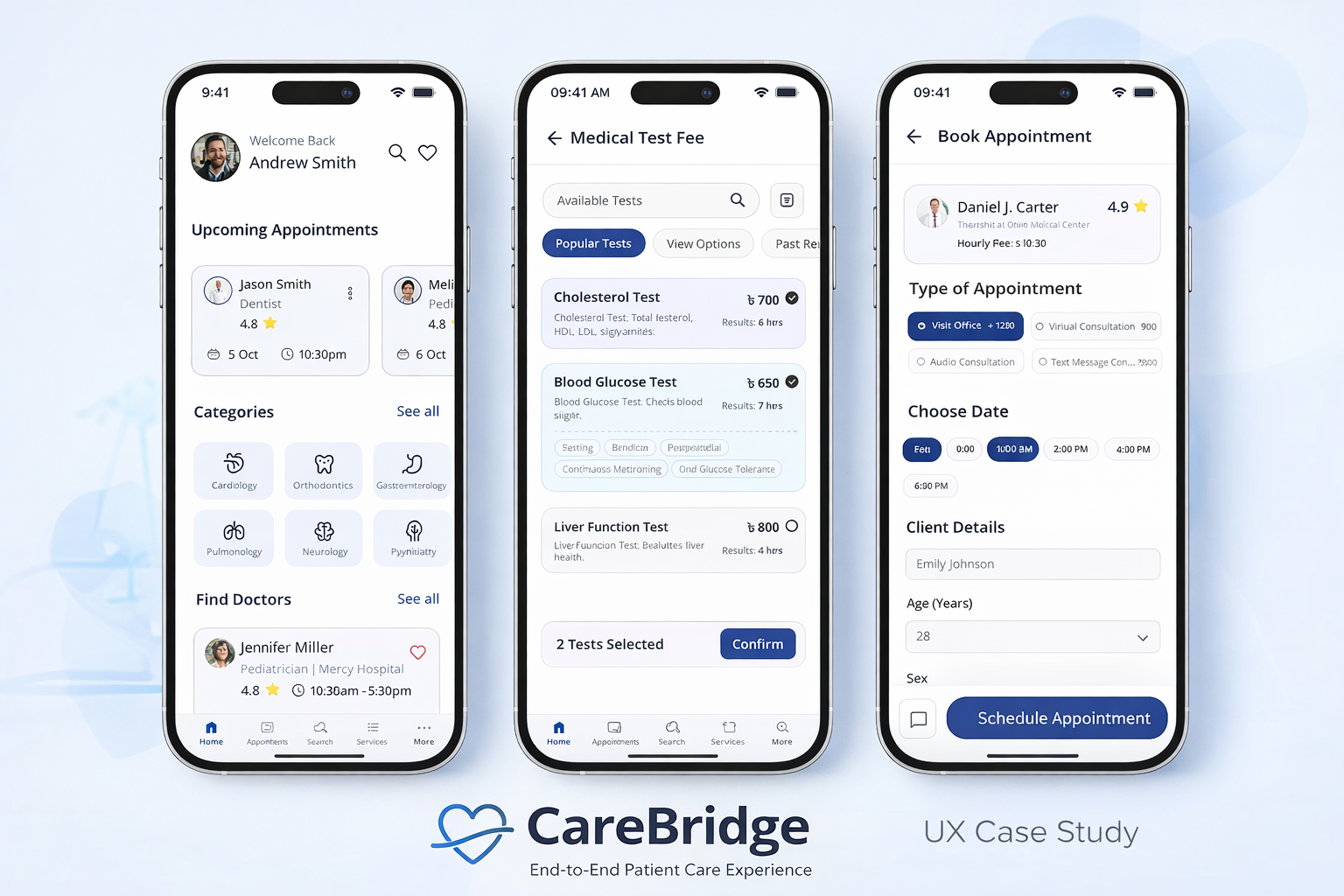
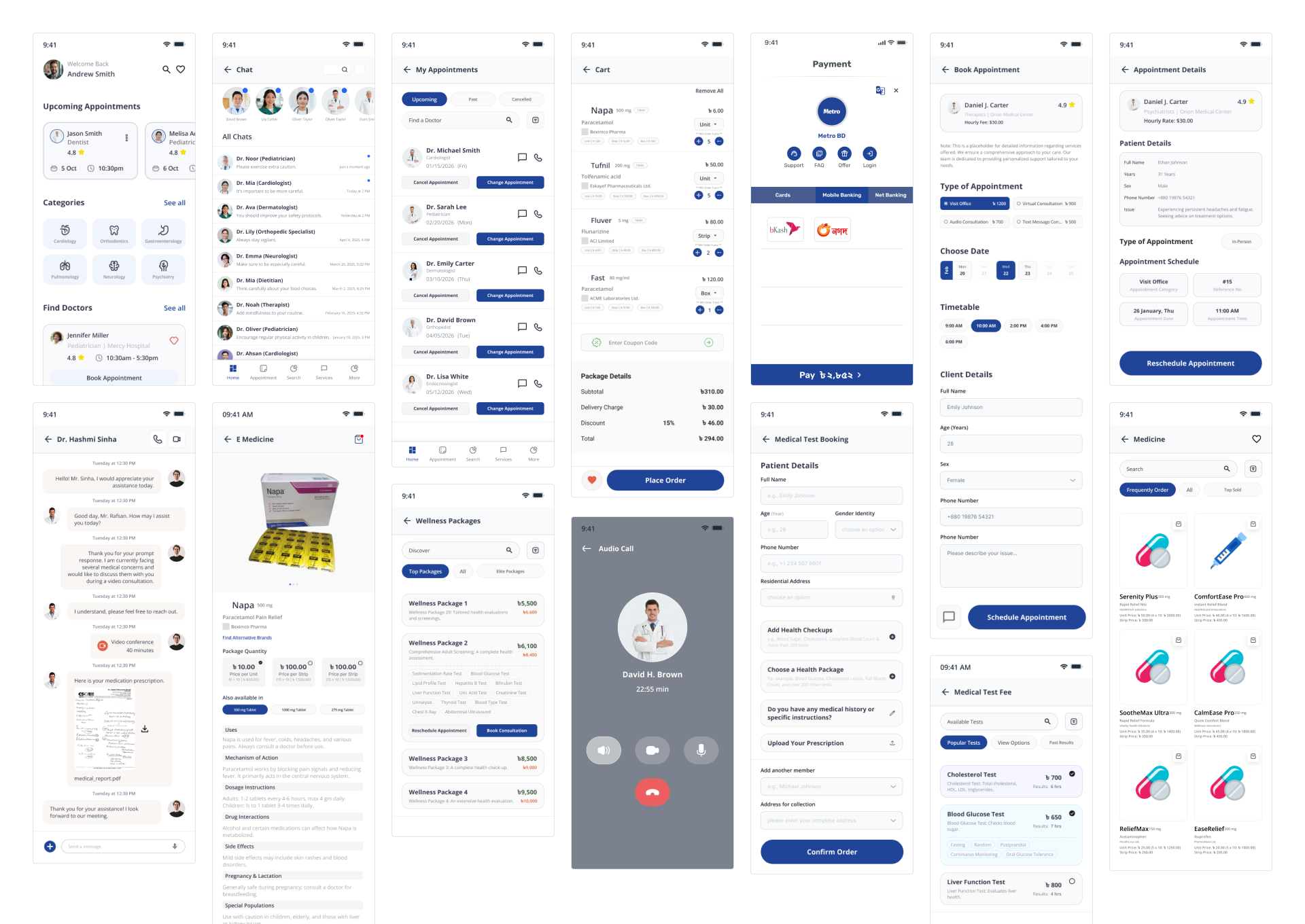
This project is a mobile-first digital healthcare platform designed to centralize essential healthcare services—doctor appointments, lab tests, e-pharmacy, health records, and remote consultations—into a single, coherent user experience.
The platform aims to reduce friction in accessing healthcare by simplifying complex medical workflows into clear, predictable, and accessible digital journeys for everyday users.
This was designed as a full-scale healthcare ecosystem, not just an appointment-booking app.
Project Goal
The primary goal of this project was to:
Make healthcare access simpler, faster, and more trustworthy for patients through a unified digital experience.
Corend Goals
Reduce time and effort required to book a doctor appointment
Eliminate fragmentation between appointments, tests, prescriptions, and records
Provide clarity and confidence in healthcare decision-making
Support both in-person and remote healthcare workflows
Design an experience usable by non-technical and older users
Problem Statement
Healthcare services are often scattered across multiple platforms:
Doctor discovery is separate from appointment booking
Lab tests, prescriptions, and reports live in different systems
Patients struggle to:
Find the right doctor at the right time
Understand availability, fees, and visit types
Track past and upcoming appointments
Maintain access to medical records and prescriptions
This fragmentation leads to:
Increased cognitive load
Appointment drop-offs
Low trust in digital healthcare tools
Repeated manual effort for recurring healthcare needs
UX Objectives
From a UX perspective, the project focused on:
Reducing cognitive load Each screen supports a single decision or action.
Creating predictable flows Healthcare actions should feel familiar and repeatable.
Ensuring continuity of care Appointments, consultations, reports, and medicines are connected.
Designing for accessibility Clear language, readable layouts, and forgiving interactions.
Target Users
Primary Users
Patients aged 18–60+
Users booking for themselves or family members
Individuals managing recurring medical visits
Secondary Users
Caregivers
Users relying on teleconsultation and chat-based care
Patients managing long-term conditions
UX Approach & Key Design Decisions
1. Unified Healthcare Dashboard
The home screen acts as a healthcare control center, surfacing:
Upcoming appointments
Doctor discovery
Core services (tests, pharmacy, records)
UX Rationale: Users should immediately see what matters now, not everything the system can do.
2. Simplified Doctor Discovery
Doctor search supports:
Specialty-based browsing
Keyword search
Filters by location, category, and shift
UX Rationale: Healthcare search should reduce uncertainty, not introduce more choices.
3. Step-by-Step Appointment Booking
The booking flow breaks down into:
Doctor selection
Appointment type (in-person, video, audio, chat)
Date and time
Patient details
Confirmation
UX Rationale: Separating decisions prevents errors and reduces abandonment.
4. Appointment Management & Continuity
Users can:
View upcoming, past, and canceled appointments
Reschedule or rebook quickly
Revisit previous doctors
UX Rationale: Healthcare is recurring—systems must support repetition gracefully.
5. Integrated Lab Tests & Wellness Packages
Users can:
Choose individual tests or bundled packages
View pricing and turnaround times
Manage orders through a unified cart
UX Rationale: Bundling reduces decision fatigue and increases clarity.
6. Centralized Health Records
All medical records are accessible in one place:
Reports
Prescriptions
Invoices
UX Rationale: Patients should never have to “search” for their own health data.
7. E-Pharmacy & Medication Safety
Medicine ordering includes:
Clear dosage information
Alternative brands
Cart and coupon flow
UX Rationale: Medication UX prioritizes clarity and safety over speed.
8. Communication & Teleconsultation
Supports:
In-app chat
Audio and video calls
Prescription sharing within conversations
UX Rationale: Communication should feel like a continuation of care, not a separate feature.
Accessibility & Usability Considerations
Large touch targets for older users
High contrast for readability
Plain language and familiar terminology
Clear error prevention and confirmations
Reduced steps for frequent users
The design follows accessibility-first thinking, aligned with healthcare usability best practices.
Outcomes (Design Impact)
Streamlined end-to-end healthcare journey
Reduced fragmentation across services
Clear foundation for scalable healthcare delivery
Strong usability for both first-time and repeat users
This project demonstrates how complex healthcare systems can be made approachable through thoughtful UX design.
Future Scope & Opportunities
1. Personalization & Smart Recommendations
Doctor suggestions based on history
Test reminders
Follow-up appointment nudges
2. Accessibility Enhancements
Screen reader optimization
Voice-assisted booking
Language localization
3. Provider & Admin Dashboards
Doctor-side appointment management
Hospital analytics
Resource and schedule optimization
4. Wearables & Health Data Integration
Sync vital signs from devices
Long-term health trend tracking
5. AI-Assisted Care Support
Symptom triage
Pre-consultation questionnaires
Care pathway guidance
Key Takeaways
Healthcare UX must prioritize clarity, trust, and continuity
Reducing steps is more impactful than adding features
Accessibility is foundational, not optional
Good healthcare design supports users before, during, and after care
Final Reflection
This project showcases my ability to:
Design end-to-end healthcare systems
Translate complex medical workflows into usable digital experiences
Balance user needs, safety, and system scalability