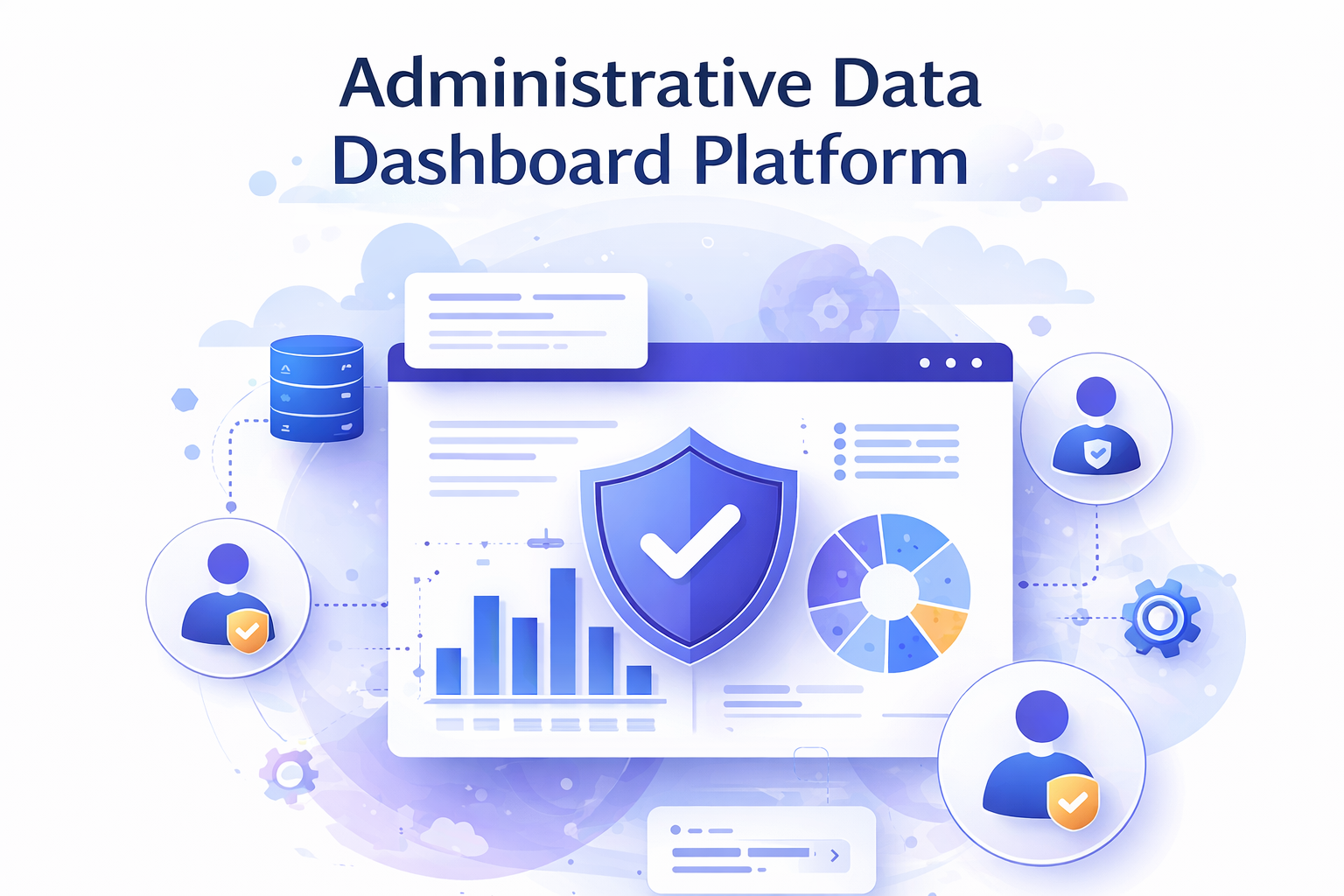
This project centers on a data management and visualization platform built to support the full administrative lifecycle of analytics configuration—from data ingestion to secure, role-based dashboard access.
The platform enables:
Integration of SQL and API data sources
Definition of validation, transformation, and summarization logic
Configuration of interactive dashboards
Controlled access through role-based assignment
The system is structured to support complex technical configuration while maintaining clarity, auditability, and accessibility in large-scale organizational environments.
Problem
Many organizations depend on manual reports, static dashboards, and ad-hoc queries, which introduces systemic issues:
Data remains fragmented across multiple sources
Reporting changes require engineering involvement
Raw metrics are difficult to interpret without domain expertise
Role-based access is inconsistently enforced
Existing tools lack keyboard and screen-reader accessibility
A centralized, self-service analytics system with built-in governance was required.
Solution
The platform is organized around a lifecycle-driven configuration model that guides administrators through a clear, dependency-aware workflow:
Data ingestion and optional composition
Parameter and constraint definition
Data transformation and summarization
Visualization and interaction behavior
Role-based assignment and access control
The UI applies progressive disclosure, validation-first interaction patterns, and embedded access governance to reduce configuration errors while supporting advanced use cases.
Key Capabilities
Multi-source data ingestion (SQL / API) with optional joins
Expression-based validation for dashboard inputs
Field value mapping for readable, decision-ready insights
Interactive, table-based visualizations with drill-down behavior
Role- and entity-level access control
WCAG 2.1 AA–aligned keyboard and screen-reader support
Outcomes
Reduced operational dependency on engineering for reporting changes
Faster dashboard configuration and iteration cycles
Improved interpretability of analytical data
Consistent enforcement of access and compliance rules
Increased accessibility across administrative workflows
Key Learnings
Complex systems benefit from clear mental models, not reduced capability
Early validation prevents downstream configuration failure
Governance and compliance are most effective when enforced through UX
Accessibility must extend beyond end-user views into administrative tooling
Note on confidentiality:
Certain implementation details and interface screens have been intentionally abstracted to respect confidentiality obligations. The material shown focuses on system design, workflow structure, and accessibility principles. Additional context and design rationale can be shared through appropriate professional channels if needed.